

RadioCult Breaks Down How to Choose Online Radio Software by Station Type

The RadioCult homepage, where broadcasters can start a 24/7 online radio station with scheduling, live and automated broadcasting, and unlimited concurrent listeners.
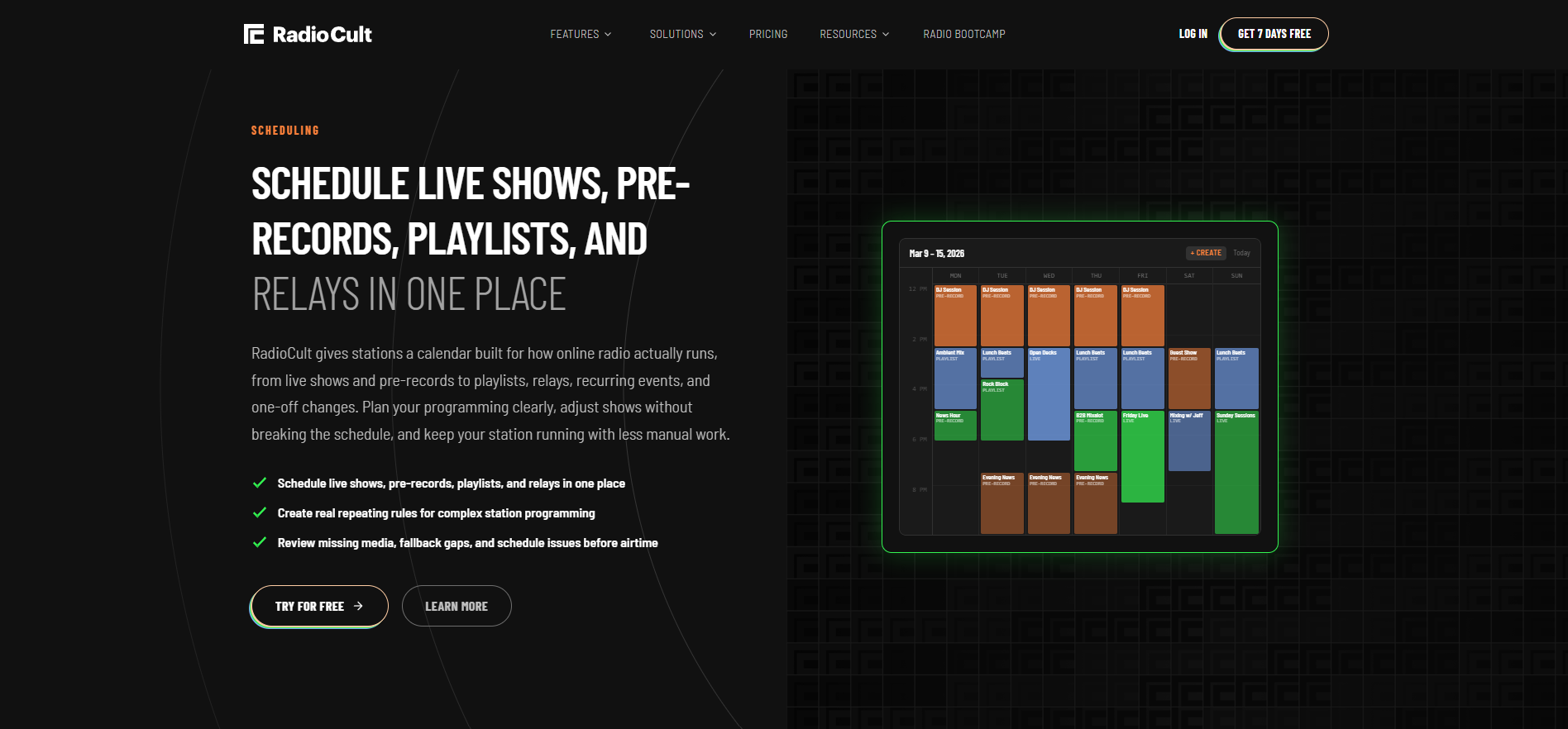
RadioCult's scheduling calendar, showing a week of live shows, pre-records, playlists, and relays in one view, with recurring rules and checks for missing media before airtime.
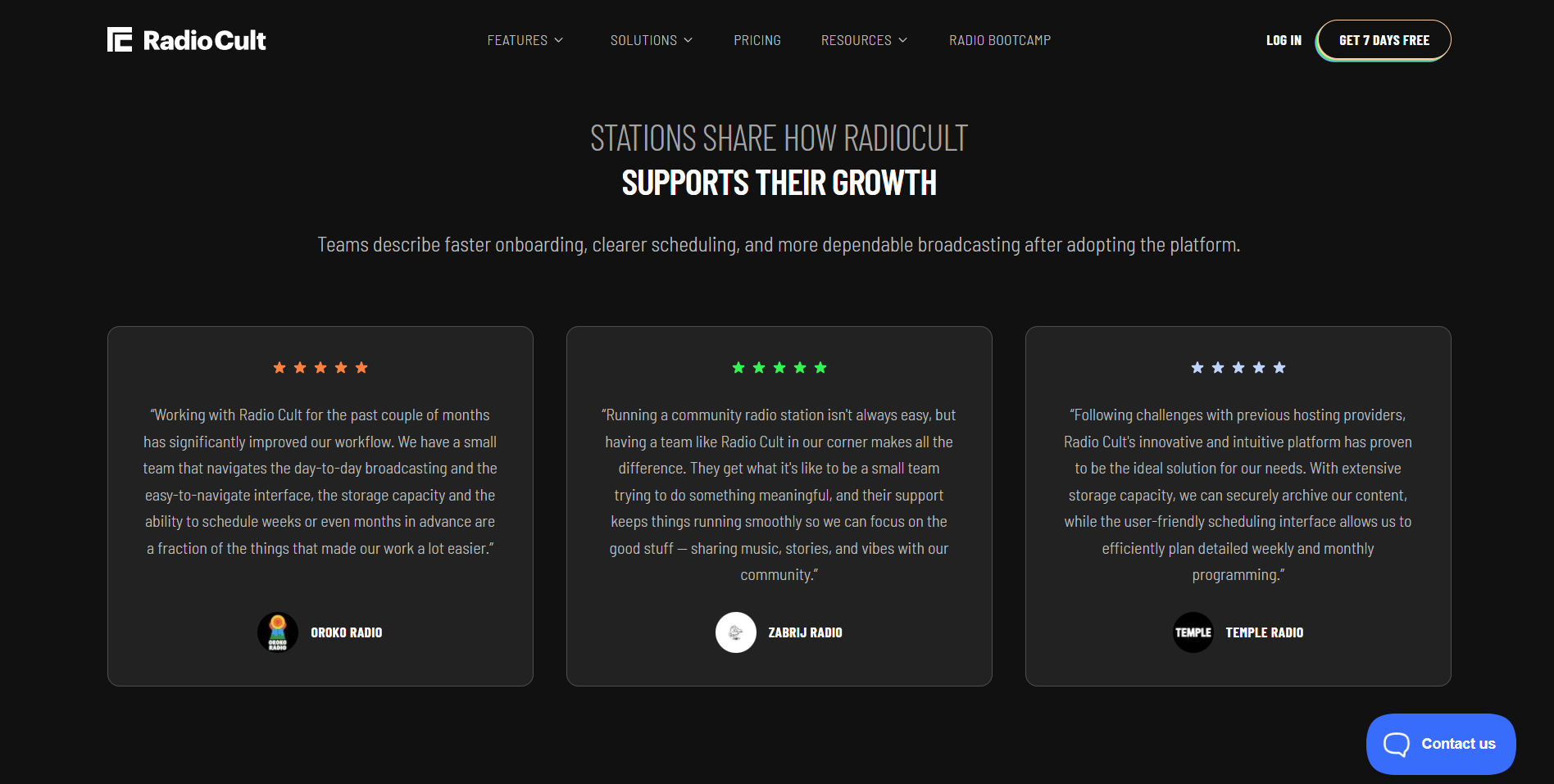
Independent and community stations, including Oroko Radio, Zabrij Radio, and Temple Radio, describe faster onboarding, clearer scheduling, and more dependable broadcasting with RadioCult.
How many people go on air, how much runs unattended, and who keeps it running: why the right online radio platform depends on the kind of station.
Three questions place most stations quickly. How many hours a week are live, and how many are automated? How many people go on air? And who keeps the station running when something breaks? The answers matter more than any feature list, because they decide which criteria carry the most weight.
The occasional or solo broadcaster needs the least. The types of internet radio software fall into three groups: encoders that push live audio to a server, broadcasting suites that add a music library and scheduling, and all-in-one platforms that include the streaming host itself. Someone going live for a few hours a week may be well served by an encoder and a basic host. The case for a full platform grows as the schedule, the team, or the audience does.
Stations built around many presenters face a different first question: how is access given and taken away as people come and go? Community stations, DJ collectives, and student stations all run rotating lineups, and student stations turn over most of their roster every term. The deciding criteria here are a shared schedule, defined roles, and live access tied to an assigned slot, so a presenter can go on air for their show and nobody has to hand out and recover passwords.
Always-on music stations ask what happens when nothing is scheduled or a live feed drops. For them, automation is the product rather than a convenience. AutoDJ to fill gaps, fallback content, relays, and checks that flag missing media before airtime decide whether listeners hear silence at three in the morning.
"The question is rarely which platform is best," said a RadioCult spokesperson. "It is which platform fits the way your station already works, and the way it will work in two years."
Talk, news, and worship stations are organized around a weekly rhythm of live moments and recorded material: a service or a call-in show, then teaching, interviews, or repeats through the week. The first question is whether both kinds of content live on one calendar, with repeating rules for regular programming and one-off overrides for special broadcasts, so the listener-facing schedule matches what is actually on air.
Stations working toward sponsorship, grants, or listener support need evidence. Funders and sponsors tend to ask for listening figures across a season or a year, so the criterion is how long analytics are kept and whether they can be exported. RadioCult retains twelve months of analytics and does not use invasive tracking pixels, which matters to stations whose listeners expect their privacy to be respected.
Some needs cut across every type. Audiences arrive in spikes, when a show is shared or an event draws a crowd, so unlimited concurrent listeners removes the risk of a ceiling at the worst moment. Most stations also lack a dedicated engineer, which makes responsive human support and a documented migration path as important as any feature. And most stations are more than one type at once, which is why the three opening questions are a better starting point than a category label.
RadioCult describes its solutions for every kind of station on its website, alongside a guide to the types of internet radio software. Plans start at $33 per month, and every plan includes a seven-day free trial.
About RadioCult
RadioCult is an online radio hosting platform built for independent and community stations that broadcast 24/7 with multiple presenters. It combines live and automated broadcasting, radio-native scheduling, station and artist management, and unlimited concurrent listeners in one platform, with human support and pricing that starts at $33 per month. Learn more at https://www.radiocult.fm.
Corey Haines
Conversion Factory
Visit us on social media:
Instagram
Facebook
X
Legal Disclaimer:
EIN Presswire provides this news content "as is" without warranty of any kind. We do not accept any responsibility or liability for the accuracy, content, images, videos, licenses, completeness, legality, or reliability of the information contained in this article. If you have any complaints or copyright issues related to this article, kindly contact the author above.
